
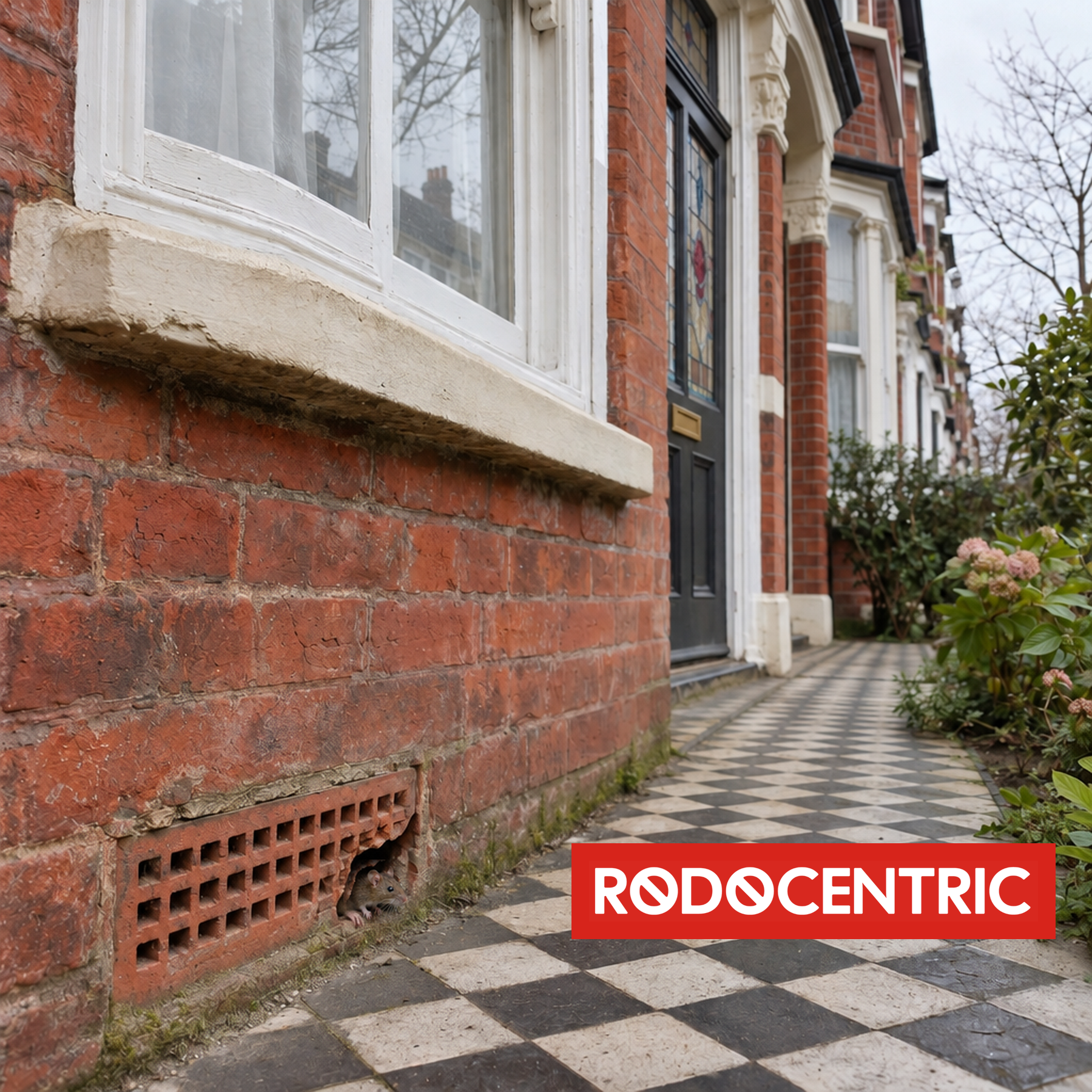
London’s Victorian and Edwardian terraces were built more than a century ago, long before anyone designed a house with rodents in mind. Suspended timber floors, air bricks, shared walls and decades of rewiring and replumbing all leave routes in.
So mice in a Victorian house are usually a building problem, not a hygiene one. Air bricks ventilate the void under the floor, but a cracked or missing grille turns one into a way in. Old pipe runs and redundant service holes often lead straight into kitchen voids.
Read on for where rodents get into period properties, and how to proof them without blocking ventilation or spoiling original features.
Why period homes are prone to mice and rats
None of this is a flaw in the house. Period homes were built for coal fires, cast-iron drains and a very different way of living. A century of change has added the gaps.
Suspended timber floors
Most Victorian and Edwardian houses have suspended timber ground floors: boards on joists, with an air space underneath. That void often runs under most of the ground floor and can connect to the house next door. It’s dark, dry and undisturbed, which is exactly what rodents look for. Scratching under the floorboards at night is a classic sign that something has found it.
Air bricks
Air bricks are there for a good reason. Historic England explains that the void beneath a suspended timber floor is ventilated through air bricks or vents in the external walls to keep air moving through the space. That airflow protects the timber. The trouble is that old clay and cast-iron vents crack, rust or go missing over time, and a damaged vent can leave an opening a mouse can slip through.
Shared walls and voids
Terraced houses share party walls, roof spaces and sometimes floor voids with their neighbours. Rodents don’t respect boundaries, so activity in one house can travel along the terrace. Sealing your own routes in is what keeps the neighbours’ problem next door.
Chimney breasts and old fireplaces
Disused fireplaces, removed chimney breasts and boxed-in flues can leave hidden voids that run from the ground floor towards the roof. They’re ideal travel routes, and they’re often out of sight behind decorative features.
A century of services
Gas lighting, then electrics, then central heating, then broadband: every service added to a period home leaves a hole somewhere. Redundant pipe runs and cable entries are rarely filled properly when they’re taken out of use, and many lead straight into the voids behind kitchen units.
Older drains
Rats bring their own routes. Hounslow Council notes that rats are known to infest drains and sewers, and that they gnaw at wood, lead and soft metals, electrical wiring and water pipes. In older properties, a defective or redundant drain connection beneath the floor can give rats a way into the floor void.
Mice or rats? Reading the signs in an older house
Sound alone rarely settles it. Floorboards and lath-and-plaster ceilings carry noise, so a mouse can sound bigger than it is. The physical signs are more reliable:
Droppings. Mouse droppings are small and about the size of a grain of rice. Rat droppings are larger, dark and cylindrical, up to around 2cm long.
Gnaw marks. Look along skirting boards, at the bottom of doors and on pipes or cables in cupboards.
Smear marks. Dark, greasy lines along the base of walls show a regular route.
Smell. An established rat problem often brings a distinctive musty odour.
Knowing which you’re dealing with matters, because rats and mice use different routes and can get through different gap sizes.
How to proof a period home without spoiling it
The aim is simple: close the ways in and keep the character you bought the house for.
Keep air bricks working
Air bricks should never be blocked. Damaged or oversized vents can be protected with fine stainless steel mesh, which keeps rodents out while letting air flow through, so the floor void stays ventilated.
Do the work out of sight
Proofing doesn’t have to show. Metal plates can be fitted behind skirting boards rather than over them, and in cupboards, under-stair spaces and service voids where they won’t be seen from living areas.
Start where problems start
In most homes, that’s the kitchen. Proofing sometimes means removing kitchen units to reach the gaps behind them, then refitting everything so the kitchen looks the same afterwards. Junctions, pipe entries and service openings are sealed with metal plates, stainless steel mesh, anti-gnaw fabric and sealants.
Respect original features
Original floorboards, fireplaces, cornicing and joinery are worth protecting. Good proofing works around them, using humane methods and durable materials rather than quick fixes, and where access means lifting a board or removing a panel, the aim is to put it back as it was.
Renovating? Proof while it’s open
If a new kitchen, rewiring or replumbing is on the cards, that’s the best moment to think about proofing. Floors are up, units are out and the gaps are exposed. Sealing them before everything is boxed back in is quicker and less disruptive than coming back later.
Keep the character, close the gaps
Period homes don’t have to come with mice and rats. Rodocentric works across London, Kent and the South East, from Victorian terraces in Clapham, Fulham and Wandsworth to Edwardian homes in Dulwich and Blackheath. Whether it’s a rodent proofing job on a single kitchen or a whole floor void, it starts the same way: book an assessment for an honest report on where rodents are getting in and what it takes to stop them.